Menu
Close
Lunchtime Art Bite: 16 April 2026
Installation of The DNA of Colour: ILDIKO KOVACS at the Drill Hall Gallery, 21 June — 11 August, 2019. Left side, LOTUS. Photo: Rob Little
Apr 16, 2026
Works viewed and discussed during the April 16 Lunchtime Art Bite at Lowitja O’Donoghue Cultural Centre foyer included paintings by Naata Nungurrayi, Emma Beer and Ildiko Kovacs. For your interest we have collated further information on their art practices and works here.
Ildiko Kovacs, Lotus, 2017, oil on plywood, 180 x 180 cm. ANU Art Collection, acquired 2019.
The exhibition The DNA of Colour: ILDIKO KOVACS was curated by Sioux Garside for Orange Regional Gallery and at the Drill Hall Gallery, 21 June — 11 August, 2019. Garside wrote:
In thinking about Kovacs’ abstract paintings I was struck by the resemblance of her spiralling lines to the coils of DNA. Her rippling forms seem to twist into a vortex or follow an unravelling double helix pattern. The DNA code is a metaphor for the way these paintings unfold and move with colour, sparked by an excavation of inner feelings and intuition…Rippling is a term that scientists used to describe the movement of gravitational waves first discovered as ‘ripples in the fabric of space-time’ by Albert Einstein in 1905–08.
Ildiko Kovacs [born 1962] is one of Australia’s foremost contemporary abstract artists…(She) studied painting at the National Art School in Sydney and has exhibited widely throughout Australia, with solo exhibitions held regularly since 1988.
In 2010 Kovacs began to improvise a new style of paintings made with paint rollers on plywood. In these sumptuous paintings the vibrancy of colours and forms do not simply evoke deep feelings or intuitions; the paintwork itself becomes a record or visible trace of the act of painting. Our experience of looking at these paintings is both sensory and kinaesthetic.
We follow the action of the artist’s body and arm via the movement of the loaded paint roller as it layers and weaves relationships in time and space, curling, overlapping or intertwining lines like twin strands of an unravelling double helix of DNA code.

Naata Nungurrayi (c.1932-), 10 panels from the Iconography series 2011-2014 – each panel 183 x 244 cm, acrylic on canvas. ANU Art Collection. Donated through the Australian Government’s Cultural Gifts Program by Craig Edwards in memory of Edmund Charles Edwards and Alan Edmund Edwards, Teachers.
Naata Nungurrayi was a Pintupi artist. She was born at Kumil, a rockhole west of Pollock Hills, near the present-day community of Kiwirrkurra in Western Australia.
The ten panels displayed in the Lowitja O’Donoghue Cultural Centre foyer at ANU are part of an epic cycle of 155 canvases painted by Naata Nungurrayi very late in her life. Her Iconography series consists of large-scale line drawings in black paint inscribed on to canvases primed with a resplendent ruby red. As such, this series marks a break with Naata’s earlier style and with the usual characteristics of Western Desert painting, since there is no elaboration, no filling-in, no more “dots”.
Naata began the Iconography series when she was in her 79th year. She had determined that the paintings would expose the bare bones of her “Dreamings”, reduced here to their essential lines.
Naata started her career in painting in 1994, living in the sparsely populated town of Kintore, 530 km west of Alice Springs, near the border between the Northern Territory and Western Australia. She was already in her 60s and a respected elder of the Pintupi people. She began producing commissioned work for the Papunya Tula artists agency in 1996, from whence her fame spread.
Because of her age, family lineage and moral authority, the subject matter of her paintings (her “Dreamings”) has an unusual scope and significance within her community. Her imagery may refer to sacred women’s sites and women’s ceremonies in the Kintore and Kiwirrkura region, while she is also one of the few women who have the authority to represent aspects of the Tingari story, which is normally the prerogative of men.
The Tingari are a group of mythical characters who travelled over vast stretches of country, establishing rituals and creating particular sites. Their travels and mystical deeds are enshrined in the song, dance and story cycles which are sacred lore to the Pintupi people.
Another exceptional feature of these paintings is their explicit reference to rock engravings in the Central Desert. Many of the engravings are tens of thousands of years old, yet they remain legible to those, like Naata, who were raised in a traditional nomadic life.
Tina Baum, Senior Curator First Nations Art, from the National Gallery of Australia writes: ‘Nungurrayi is a well-respected artist and Elder whose paintings evoke the depth and beauty of her Country, culture and ancestral stories. Without the artist’s insight her paintings reveal little of their associated stories, but viewers are rewarded aesthetically and, once the stories are revealed, culturally.” (https://digital.nga.gov.au/archive/exhibition/undisclosed/default.cfm%3Fmnuid=artists&galid=37849&viewid=3.html, accessed 15.4.26)
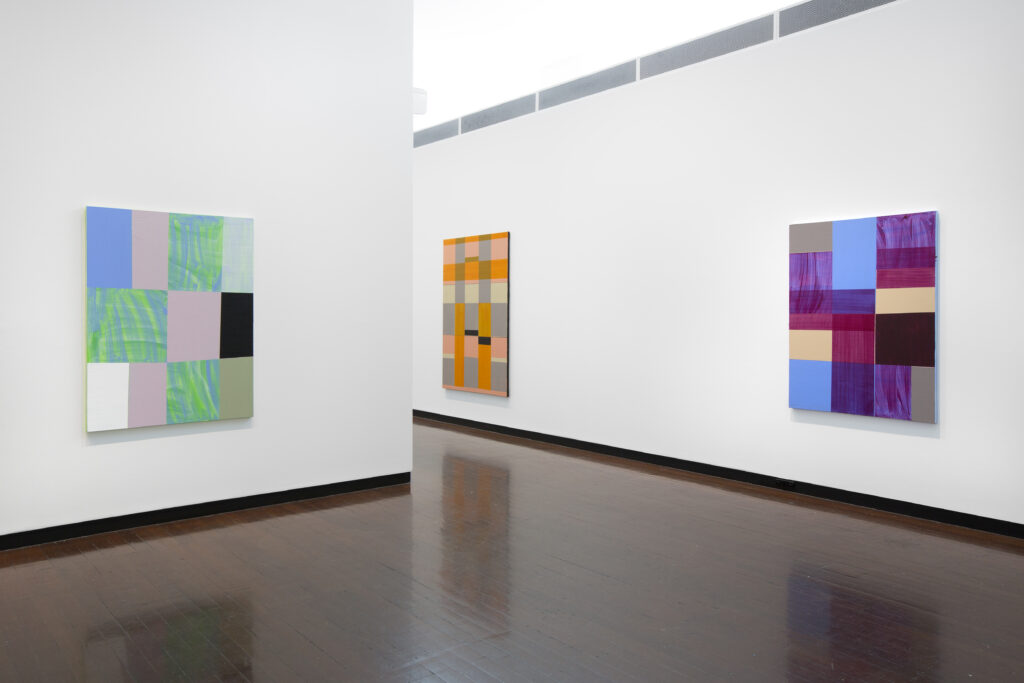
Emma Beer, Soosey binge party, 2021, acrylic on canvas, 140 x 110 cm. ANU Art Collection, acquired 2022,
and Emma Beer, An outrigger of my thinking, 2021, acrylic on canvas, 140 x 110 cm. ANU Art Collection, acquired 2022.
“When making these paintings or more specifically when I think about making these paintings…I think about two things; raw material and pure sensibility.” Emma Beer
The Drill Hall Gallery worked with Canberra artist Emma Beer, the youngest artist to present a solo exhibition in the Gallery’s history, for the exhibition Emma Beer: Zooper Dooper, ANU Drill Hall Gallery, 10 February to 10 April, 2022. Developed in response to the scale and architecture of the exhibition space, Emma Beer’s body of work embodied the enigma of light. Exhibition curator Tony Oates wrote:
Energised and resonant, shimmering with vitality, these works are alive to all of light’s permutations, responsive to its delicate shifts in tone and hue, shade and shadow. Characterised by this mutability, Beer’s layered fields create radiant interactions of space and depth: paint is stretched, pulled and manipulated, pigments are thinned, veiled and extended, before being reconfigured as strident skeins that block and structure.
“The most conspicuous things about my painting” writes Emma Beer, “is the assertive tension between surface and space, the energised and ethereal colour relations and the engaging duality and inversion of both substance and method”
While the motivation and outward presentation of Beers’ painting may be dedicated to the formal capacities of paint, an undeniable and tangible parallel exists in her work, of human presence and of our relation to space and time:
“I work relentlessly in opposition, to activate sensations (physical, mental and emotional) that explore every infinite possibility. From happiness, sheer joy and excitement, to pain, sorrow and despair.”
While these are well and truly process paintings, they remain open to all possibilities.
An alumni of the ANU School of Art & Design Beer has augmented her studio practice over the last decade through her participation in communities of painterly concern and her work could be seen as emblematic of the energy in the Canberra arts community.
The Drill Hall Gallery acknowledges the Ngunnawal and Ngambri peoples, the traditional custodians of the Canberra region, and recognises their continuous connection to culture, community and Country.
Contact
Close
Subscribe
Close
Close