Menu
Close
Highlights from the ANU Art Collection: Elizabeth Newman
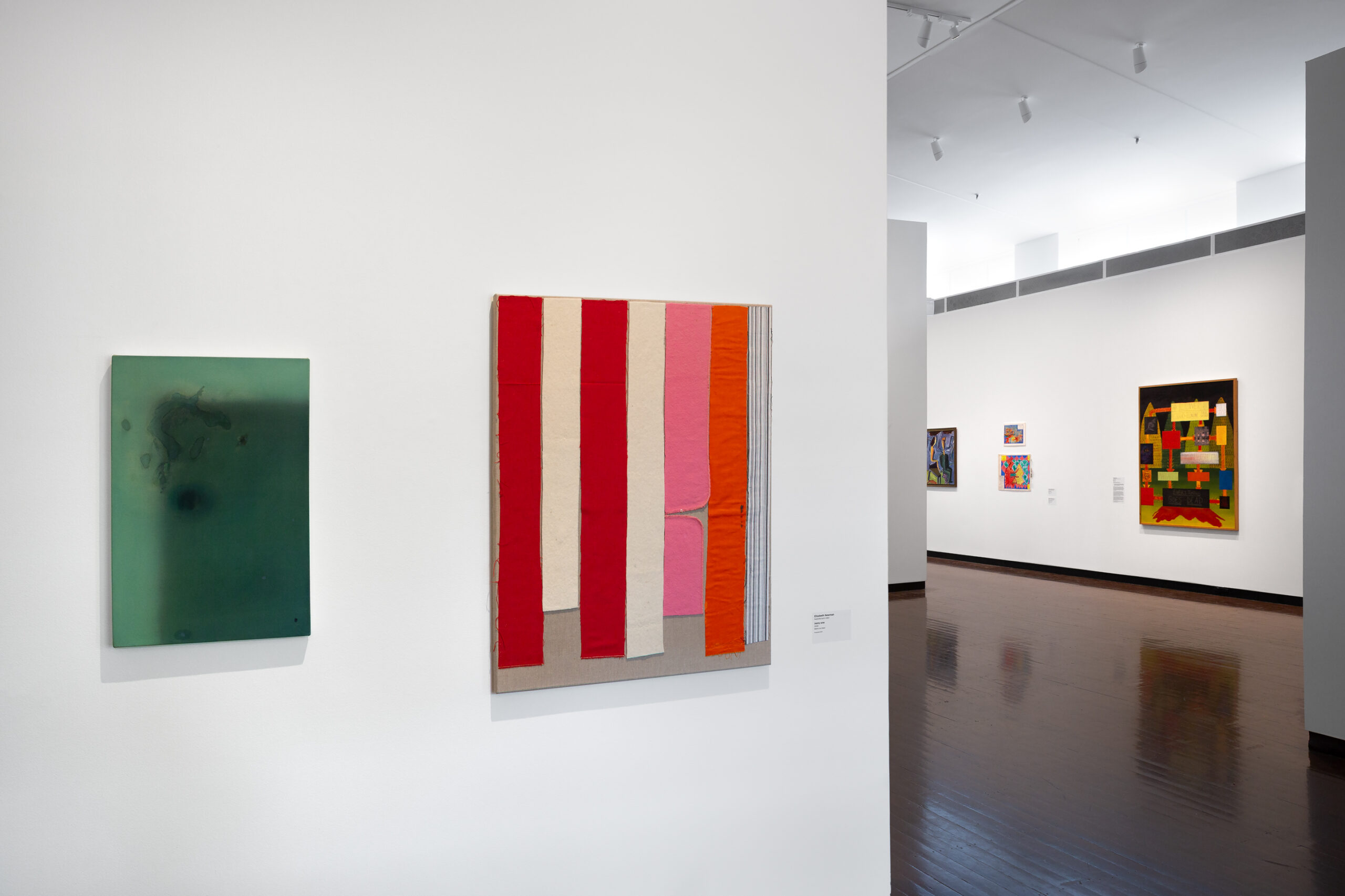
Elizabeth Newman, Jazzy one 2009, fabric on linen, 108 x 85 x 3.5 cm. Acquired 2021. ANU Art Collection.
Dec 2, 2025
|
Collection
Jazzy one 2009
fabric on linen, 108 x 85 x 3.5 cm
Acquired 2021
Elizabeth Newman studied painting at the Victorian College of the Arts in the 1980s. Her practice opens beyond painting as Newman focuses on what she terms “fresh and awkward” artworks. By continually switching mediums and materials – paintings, collages, landscapes, found objects, drawings, monochromes, text-works, installations, ready-mades, clothing, sculptures – Newman carefully avoides any technical mastery. Her art is characterised by broad variety on the one hand and genuine consistency on the other, with an exploration of representation and subjectivity running through it all.
Newman has a history of invoking painting and its discourses via objects and places which have no prior relation to art. In offcuts of material, cardboard boxes, discarded packaging, abandoned office furniture or timber ready for the scrap heap, Newman proposes painting without painting. In collages such as Jazzy One, the form, dimensions and materiality of Newman’s found fabrics approximate the physical conditions of a modernist abstraction. Scaled in relation to the body, evidently tied to an abstract conception of the image through its altered radiance, clarity, vitality and cohesion, the work functions as a ‘stand-in’ for painting.
By appropriating objects from the ‘real’ world, and utilising collage Newman seeks to “interrupt the seamless surface” of painting and blur the line between material literalness and the impalpable image. These works often pivot around reversals of positive and negative, affirming the plasticity of space and the ambiguous character of the void. “I like to bring ‘the nothing’ into being for some reason. Making a cut, finding a hole; pointing to a void”. Newman’s art emphasises an inherent division in her subjects – of inside and outside, object and illusion; here, an object corresponds to the breadth of its possibility. As the poet Francis Ponge wrote:
Only here can we see how, in the void, things are made and unmade, how they are born and die and are reborn different, by the permutation of their elements. And so we see the whole, where nothing is ever created out of nothing.
—
On show in ANU Art Collection: Conjunction, 24 October – 21 December 2025
The Drill Hall Gallery acknowledges the Ngunnawal and Ngambri peoples, the traditional custodians of the Canberra region, and recognises their continuous connection to culture, community and Country.
Contact
Close
Subscribe
Close
Close