Menu
Close
Highlights from the ANU Art Collection: Hilarie Mais
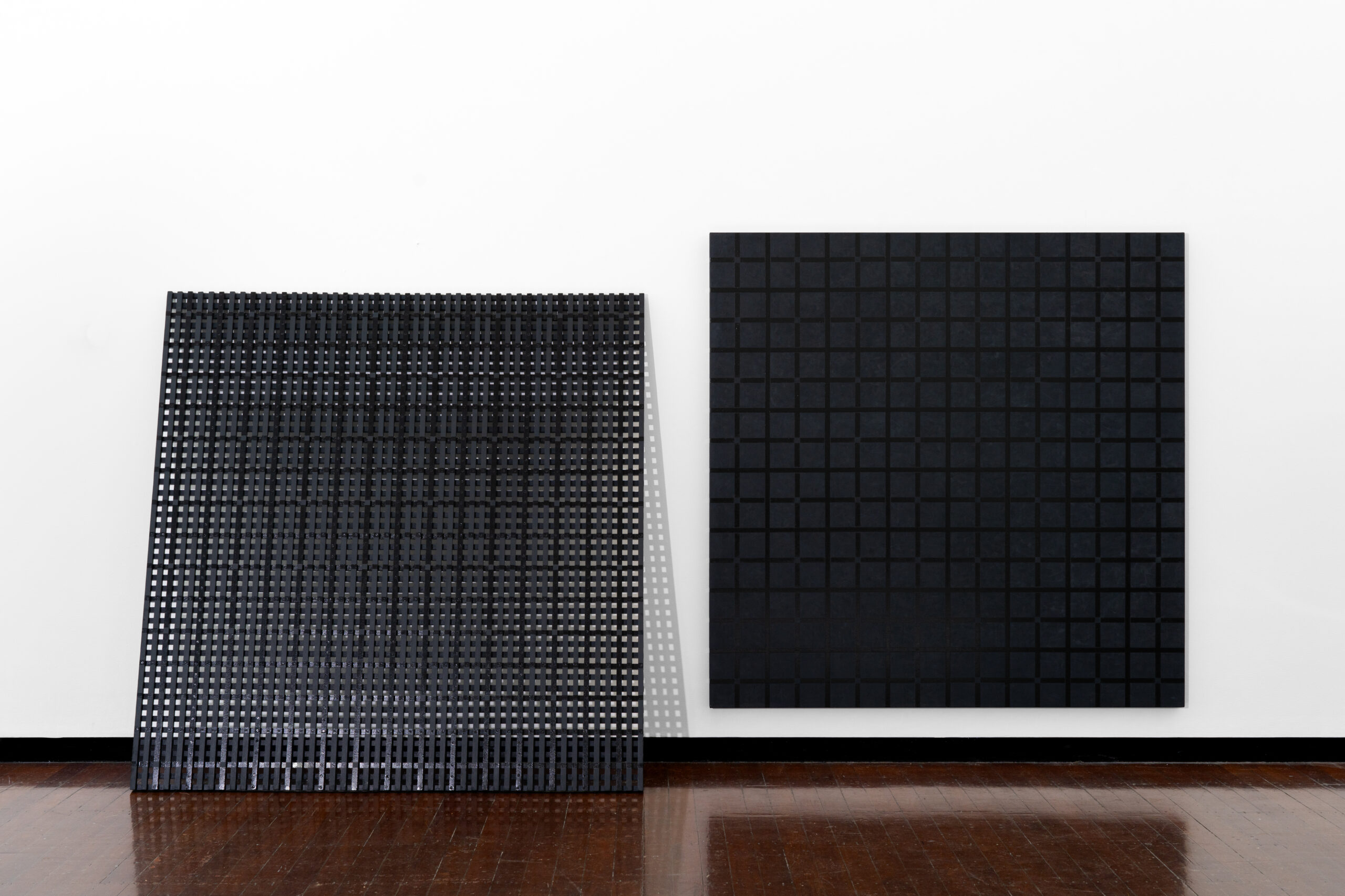
Hilarie Mais, Effigy 1996–98, oil on timber and oil on canvas, 183.5 x 179 x 4 cm (timber), 179 x 179 x 4 cm (canvas). ANU Art Collection. Gift of Drew Ilsley, 2005
Dec 11, 2025
|
Collection
Hilarie Mais, Effigy 1996–98
oil on timber and oil on canvas
183.5 x 179 x 4 cm (timber) 179 x 179 x 4 cm (canvas)
Gift of Drew Ilsley, 2005
Since the 1980s, Hilarie Mais has returned insistently to the grid—a structure she describes as “a non-hierarchical place, a democratic site, a place of serenity, proportion, surface, tone, balance and harmony.” For Mais, the grid becomes both a measure of lived experience and a quiet architecture of endurance, a form through which the “optical unconscious” can slip and flare in the spaces between.
Effigy is a doubled work, poised between two and three dimensions. A hand-built wooden grid—its span drawn from the width of the artist’s outstretched arms—leans gently against the wall. Beside it hangs its planar companion: a painted canvas that echoes the sculpture’s scale and structure. The sculptural grid inhabits our physical world, casting its shadow across the wall; the painting, by contrast, is composed of matte squares held within a web of reflective lines, catching and returning our movements as we pass.
Mais probes the subtle misalignments between dimensions, creating a threshold where the real and the illusory meet. With their muted, mournful palette, these works trace passages between presence and memory, life and death, the material and the symbolic. Effigy stages a quiet dialogue between painting and sculpture—not only in the suggestion of an empty frame, as though an image has withdrawn, but also in the way the sculptural form “hangs” against the wall, blurring the customary boundaries between object and image, floor and surface, body and shadow.
—
On show in ANU Art Collection: Conjunction, 24 October – 21 December 2025
The Drill Hall Gallery acknowledges the Ngunnawal and Ngambri peoples, the traditional custodians of the Canberra region, and recognises their continuous connection to culture, community and Country.
Contact
Close
Subscribe
Close
Close